
Plant
Contract Crushing Fleet
Contract fleets that move Mn kits between sites with honest handoffs.
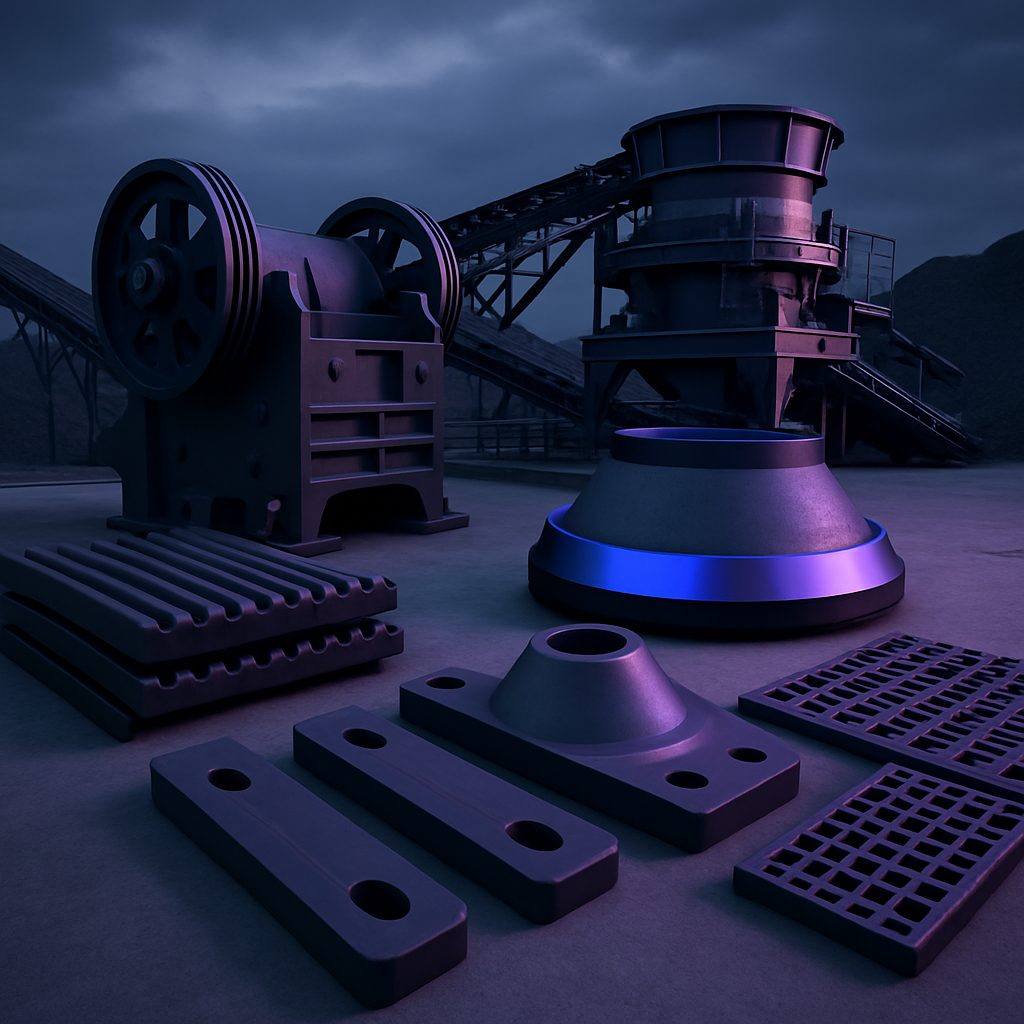
Parts for this plant
See our wear notes and printable resources for planning liner changes.
Setting up a contract crushing fleet
A contract crushing plant is built for mobility and quick turnaround, with bakkie-load kits of jaw plates, cone mantles, and blow bars regularly moving out to quarries, sand plants, or recycle sites across the Highveld, Karoo, or coastal regions. These plants are often run in two or three-stage circuits, usually starting with a jaw crusher feeding into a cone or impactor, and, where needed, a screen for sizing. They are designed to handle variable feed material and to be relocated at short notice to match shifts in contract demand.
Such circuits typically produce road stone, G5, ballast, concrete aggregate, or recycling product, depending on the feed and customer spec. Feed rates can swing quickly, and the plant needs to be set up with rapid adjustment of closed side settings and screen apertures. Good material flow and feed distribution are key to keeping the circuit running smoothly, especially as contract terms often require tight turnarounds and accurate tonnage delivery.
Wear patterns and high-wear zones
Wear in a contract crushing plant tends to concentrate at the points of initial impact and along the main flow path. Jaw plates see the greatest wear at the centre of the fixed and swing plates, especially near the bottom of the crushing chamber where the nip angle is steepest, and fines are generated. With cone mantles and bowl liners, the highest wear zones are in the lower third, especially if feed is not evenly distributed or if the chamber is not choke-fed. Blow bars in impactors wear fast at the leading edge, particularly when working recycled concrete or abrasive stone.
Frequent moves and changes in feed type make wear less predictable, so visual checks and wear profiling are vital. Work hardening of austenitic manganese liners takes time, so the first few loads after a liner change can be especially critical. Liner bolts, backing compound integrity, and safe lifting with proper lugs must be checked after every move or liner swap.
Crusher Consumables parts for contract fleets
We supply jaw plate sets, cone mantle liners, and blow bar kits specially matched to contract fleet needs. Jaw plates come in OEM profile fits, with both standard and deep-toothed options, for grip on all rock types. Our cone mantles and bowl liners are cast to fit OEM chambers, with correct profile for closed side setting control and maximum throughput. Blow bar kits are available in manganese, martensitic or chrome iron, with or without ceramic inserts for longer life and better breakage resistance.
All these parts are supplied as ready-to-fit kits, with liner bolts, washers, and torque specs deferred to OEM manuals for safety. We also stock wear buttons for chutes, toggle plates that act as a fuse for tramp metal, and backing compound for secure liner seating. Each part is checked for correct fit and rotor balance in the case of blow bars, to keep the fleet running without vibration or unplanned downtime.
- Jaw plate sets for quick swaps
- Cone mantle and bowl liner kits
- Martensitic, chrome, or ceramic blow bar kits
- Liner bolts and safe lifting lugs
- Backing compound and wear buttons
Planning liner changes and stock for contract work
Production is often affected by Eskom power cuts, so campaign planning needs to factor in both scheduled and unscheduled downtime. Keep spare liner sets, blow bars, and wear buttons on hand, stowed safely in the bakkie or at the nearest yard, to avoid long stops when the plant restarts after a cut. Use power cuts for changeouts, with all machines locked out and safe lifting practices in place.
Stock planning is best organised around planned moves and known site demands. Track wear rates with regular inspections and keep a run sheet of liner hours per site. Screen media, whether polyurethane or wire mesh, should be checked for correct tension and regular aperture, as pegged or slack panels slow down production. For contract fleets, the key is to keep enough core wear kits on hand to cover the next move, but not overload the bakkie.
What our Crusher Wear Parts customers say
Verified Google reviews