Plant
Coastal Aggregate
Coastal plants where humidity and salt complicate liner storage and bolts.
Parts for this plant
See our wear notes and printable resources for planning liner changes.
Working with coastal aggregate circuits
Coastal aggregate plants run up against unique operational factors due to high humidity and salt exposure. Most circuits here feature a cone crusher for secondary reduction, finishing screens for grading, and often an impact crusher on the recycle leg. Material flows from the feed hopper through the primary jaw, onto the cone for shaping, then over multi-deck screens. The circuit is designed to get the right grading: 6 to 19 mm road stone, concrete sand, and fine crusher dust. Ensuring consistent feed is key to maintaining choke conditions in the cone and keeping screen separation sharp.
Salt-laden air and humidity speed up corrosion, which means plant layout must allow space for regular equipment inspection and maintenance. Pay close attention to moving parts and interfaces, as localised corrosion increases risk of seized bolts and premature liner failure.
Where wear is most aggressive and why
The cone mantle liner takes the brunt of abrasive action in the secondary stage, especially if the feed contains shell fragments or quartzite. Wear is most rapid at the closed side setting (CSS) contact, where the nip angle and chamber profile focus the compressive forces. Over time, this zone work-hardens the liner but also thins it out. Salt and humidity can prevent proper work-hardening by encouraging scaling and pitting, which must be monitored.
Screen media suffers from high humidity because moisture and salt penetrate between wire or polyurethane segments, leading to rapid corrosion at the tension hooks and apertures. Impact crushers operating near the coast see blade blow bar and anvil pitting, especially if the rotor balance is thrown out by uneven build-up or scaling. Bolts, lifting lugs, and liner seats on all these parts are vulnerable to accelerated rust, making torque retention an ongoing challenge.
Crusher Consumables parts and how they integrate
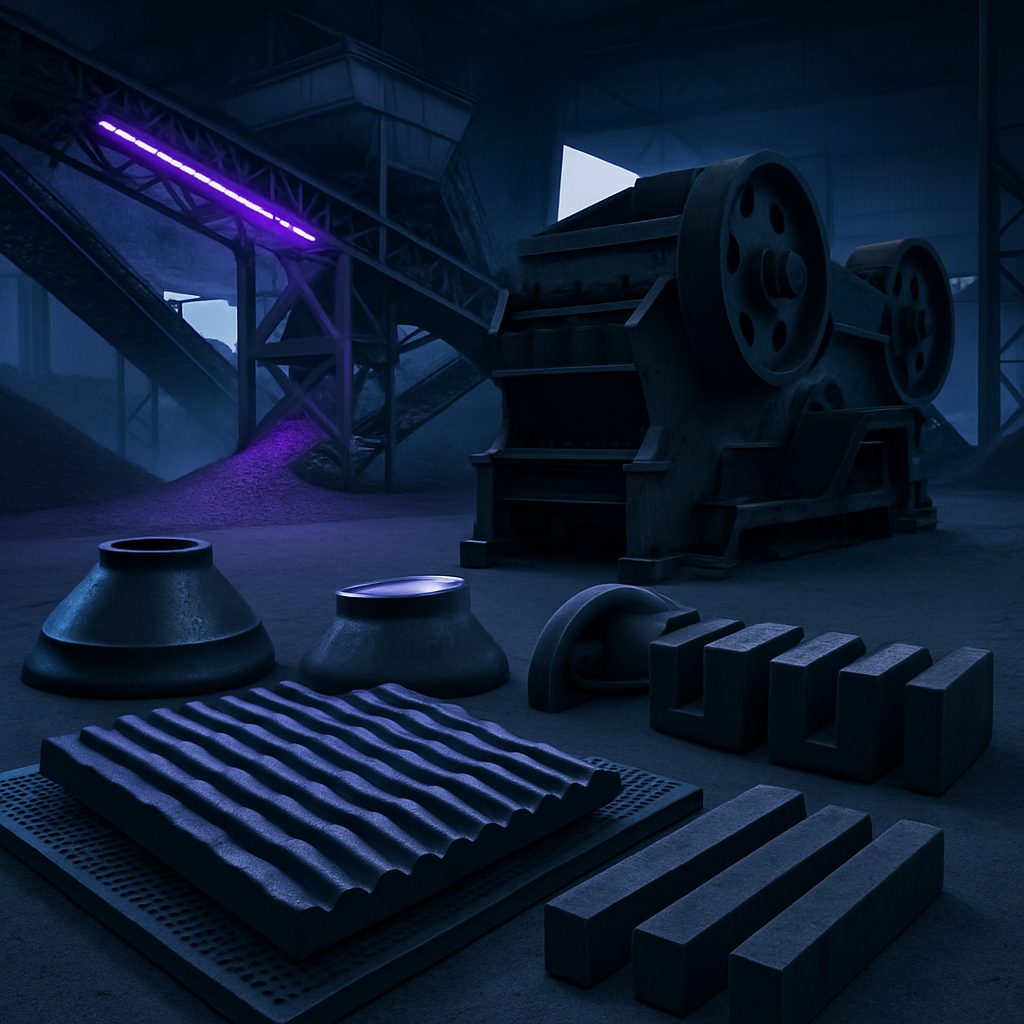
For coastal operations, we supply cone mantle liners in austenitic manganese. This alloy work-hardens at the crushing surface, resisting the abrasive fines common in marine aggregates. Each mantle is cast with oversized lifting lugs for safer handling in humid, slippery conditions. Our blow bar kits for impact crushers come in martensitic and chrome iron, with ceramic inserts to slow down edge wear from tough mineral inclusions. Rotor balance is checked on delivery, but always inspect before fitment due to coastal vibration risk.
Screen media kits are available in both high-tensile wire and modular polyurethane. Polyurethane resists salt much better but can be prone to aperture blinding if not sized to the local fines content. Wire mesh is easier to tension but will corrode faster, so plan for shorter campaigns or invest in sacrificial zinc-coated frames. All screen kits come with tension bolts and lock plates suited for humid conditions.
- Cone mantle liners: work-hardened manganese with safe lift lugs
- Blow bar kits: martensitic, chrome iron, ceramic insert options
- Screen media: wire or polyurethane, with anti-rust fasteners
Planning liner swaps and stock for coastal challenges
Coastal humidity and salt exposure demand vigilant campaign planning. Always inspect liner bolts and backing compound for corrosion before major changes. Stock at least one full set of wear parts on site, including liner bolts and screen media, as coastal corrosion can make removal tricky and delay replacements. Use colour-coded tags to track campaigns and rotation, noting start metre readings and hours run under current feed conditions.
Power cuts in coastal regions can disrupt production and delay changeouts. Plan liner swaps for early morning, before the humidity spikes or Eskom outages hit. Always follow OEM torque values for liner bolts, as salt can reduce thread friction and false-tighten fittings. Keep bakkies stocked with rust-release spray and spare nuts for emergency swaps. For advice, contact us through our contact form.
What our Crusher Wear Parts customers say
Verified Google reviews