
Plant
Roadstone Tertiary
Tertiary circuits making roadstone with tight grading and liner honesty.
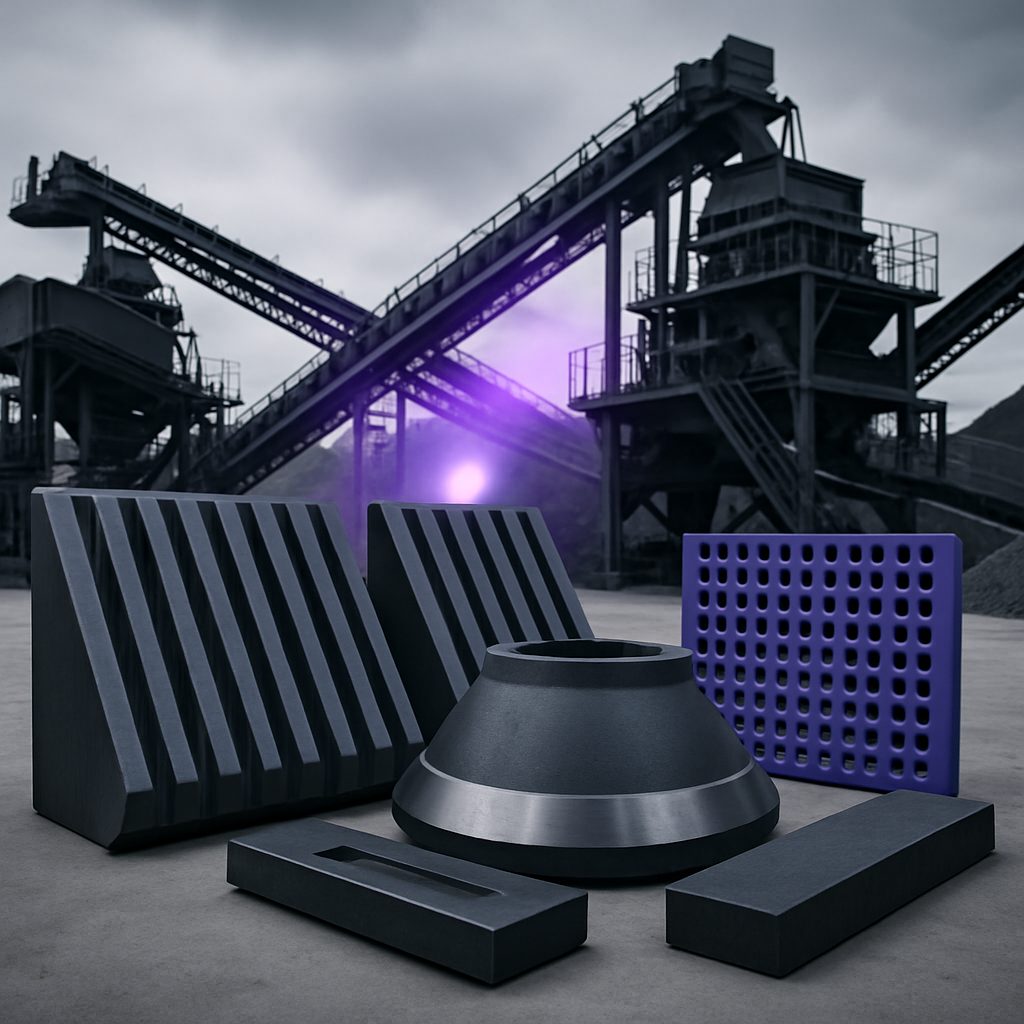
Parts for this plant
See our wear notes and printable resources for planning liner changes.
Roadstone tertiary circuit overview
A typical roadstone tertiary plant runs a closed-circuit cone crusher paired with precision screens. The aim is to produce a tightly graded, cubical product, often 6 to 19 mm, within the envelope set by South African road specifications. Tertiary cones are usually fed by aggregates pre-sized from secondary crushers. The feed is choke-fed to maximise reduction and control product shape. Screen decks are set to tight apertures, keeping oversize in recirculation and passing only the final roadstone fraction to the stockpile or surge bin. Consistent grading is critical, as deviations can compromise both surface finish and compaction in road construction.
Wear hotspots in tertiary circuits
Wear in a tertiary plant typically concentrates on the lower half of the cone mantle liner and the matching concave ring. The reason is the high velocity and volume of rock passing through the chamber's choke-fed zone, which causes rapid work hardening of the manganese liner but also accelerates localised abrasion and impact. Downstream, screen media see concentrated wear on the feed end and over the centre of the deck, where material velocity is highest. Polyurethane panels may be used for abrasion resistance, but fine wire mesh is common for close grading, especially on final product decks. Accurate monitoring of wear profiles helps avoid sudden failures and maintains grading integrity.
- Cone mantle liners wear fastest at the choke point
- Screen media wears at the feed impact zone
- Fine wire mesh is prone to blinding with damp roadstone
- Screen tension must be checked after panel changes
Parts supplied and their integration
Crusher Consumables supplies both cone mantle liners, in austenitic manganese for optimal work-hardening, and screen media kits tailored for roadstone grading. The cone mantle liner forms the primary wear surface inside the crusher chamber, maintaining nip angle and chamber profile. High-manganese liners are designed to harden under impact, extending service between changes when set up with the right closed side setting. Our screen media kits include either polyurethane panels for high-abrasion applications or precision wire mesh for fine grading, cut and tensioned to suit your deck size and aperture requirement. When ordered together, these parts ensure that grading consistency matches the crushing circuit’s throughput, reducing downtime and avoiding mismatch between crusher and screening capacity. For installation, always use certified lifting lugs and torque bolts as per the OEM manual, with proper lockout procedures.
Liner change planning and stock holding
Efficient liner and screen change planning starts with tracking throughput, wear measurements, and local factors like Eskom power cuts, which can disrupt scheduled maintenance. Plan liner changes during production lulls or outages to avoid lost tonnes. Stock at least one full set of cone mantles and screen panels onsite, especially if you’re far from Joburg or Durban. Backing compound for the mantle, extra torque-checked bolts, and spare tensioning wedges for screens should be kept handy. Campaign planning around your average production helps avoid stockouts and keeps quality roadstone on spec, even during unexpected outages or high-demand periods. For technical advice or orders, contact us through our contact form.
What our Crusher Wear Parts customers say
Verified Google reviews