Plant
Cone Secondary Plant
Secondary cones where mantle and concave geometry decide tonnage.
Parts for this plant
See our wear notes and printable resources for planning liner changes.
How secondary cone circuits are set up in local plants
Secondary cone crushing plants in South Africa typically follow a jaw primary, taking minus 180 to 420 mm feed from the primary and producing a consistently shaped aggregate for quarries and mines. The plant layout keeps the cone crusher close to the surge pile or direct from the jaw, using bakkie-sized conveyors to keep transfer times short and reduce spillage. Choke feeding is critical here, as a full crushing chamber ensures even wear and optimal reduction ratios.
The secondary cone will generally be set to a closed side setting (CSS) between 20 and 38 mm, depending on the target product. Correct feed distribution is vital. Poor feed leads to uneven liner wear and out-of-spec product. The circuit often includes a screen after the cone to split final aggregate into required size fractions, with oversize recirculated if necessary.
Where wear concentrates and what causes it
Most wear in a secondary cone plant concentrates on the lower section of the mantle liner and the middle-to-lower part of the concave set. This is where the nip angle is sharpest and material is most forcefully compressed. If the feed is misaligned or the chamber is not kept choke fed, localised hot spots develop. Fines can accelerate wear at the feed point, while oversize rocks chip at the liner shoulders.
Work hardening of austenitic manganese steel liners happens only under proper loading. If the chamber runs empty during Eskom power cuts, the liners do not harden evenly. Always check for signs of uneven wear, such as a scalloped profile, which can indicate poor feed or a worn spider bushing.
- Heavy wear on lower mantle and concave
- Feed misalignment increases localised damage
- Fines and oversize both stress liners differently
- Loss of choke feed due to power cuts affects hardening
Key parts supplied and how they interact
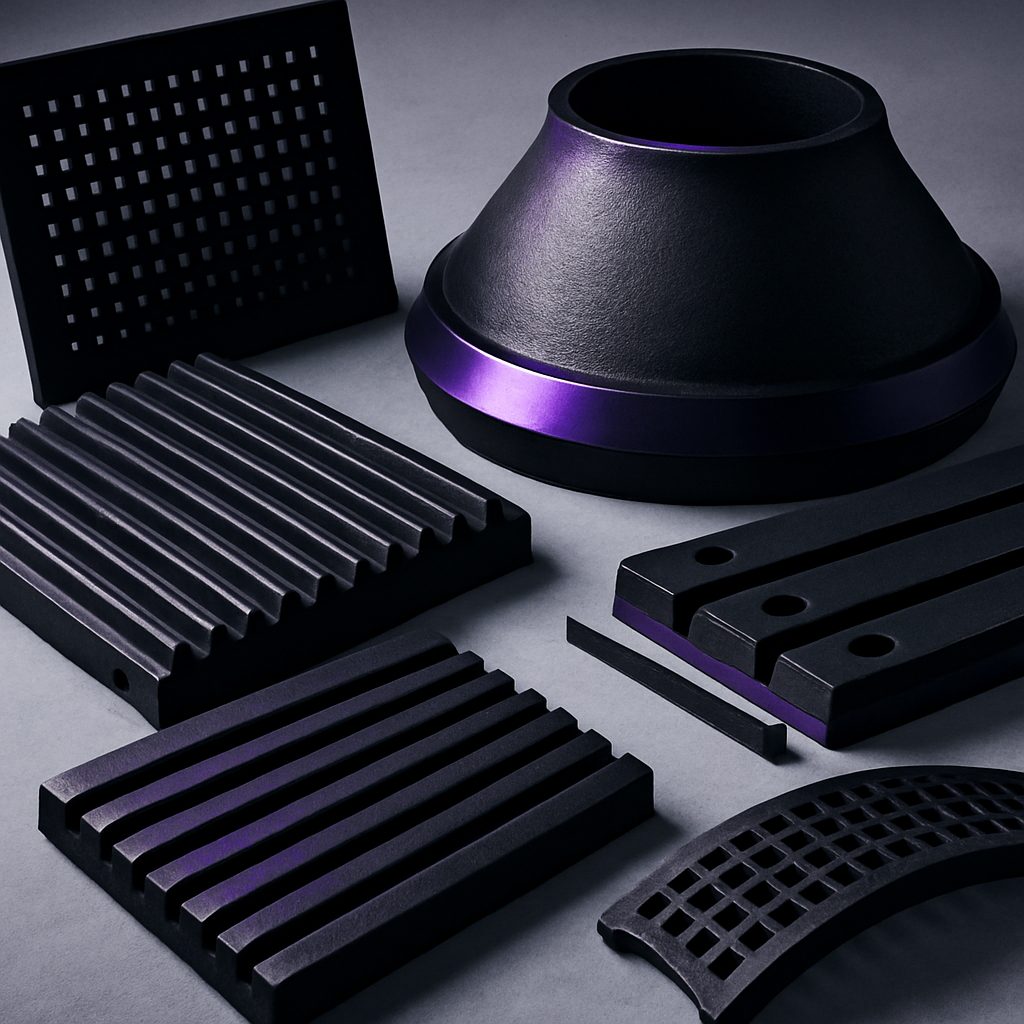
Crusher Consumables stocks critical wear parts for secondary cones, including cone mantle liners, concave sets and bowl liners, covering major OEM profiles. The cone mantle liner is clamped onto the main shaft and rotates eccentrically to crush stone against the concave set, which lines the top shell. The bowl liner is often integral with the concave or a separate piece in some OEMs, controlling the upper crushing chamber geometry.
All parts are cast in work-hardening manganese with proper profile for the chamber size and CSS. The backing compound must be poured and cured to lock liners in place, ensuring no movement under high load. Liner bolts should always be torqued as per OEM manual. Safe lifting with certified lugs is vital to prevent injury or damage during change-out.
Planning liner changes and stock during power cuts
To minimise downtime, organise liner change-outs to align with scheduled Eskom outages or maintenance campaigns. Monitor wear regularly using thickness gauges at several points on the mantle and concave. Record the wear pattern so you can predict when the crushing profile is drifting out of spec and order new liners timeously.
It helps to keep at least one full set of liners in your parts yard, especially if you run on the Highveld or in remote Karoo sites where deliveries can be slow. Plan liner swaps for cooler parts of the day to avoid Durban humidity or Cape southeaster conditions. Always lockout the plant properly and use the correct lifting gear. For all technical queries or urgent parts, contact Contact form.
- Align liner changes with planned maintenance
- Use wear checks to drive ordering cycles
- Stock at least one spare set per crusher
- Plan for slow deliveries in remote areas
- Follow OEM torque specs for liner bolts
What our Crusher Wear Parts customers say
Verified Google reviews