
Rubber Skirt and Liner Stock
Skirt strip and stud-backed rubber chute panels for the transfer points under crushers and screens.
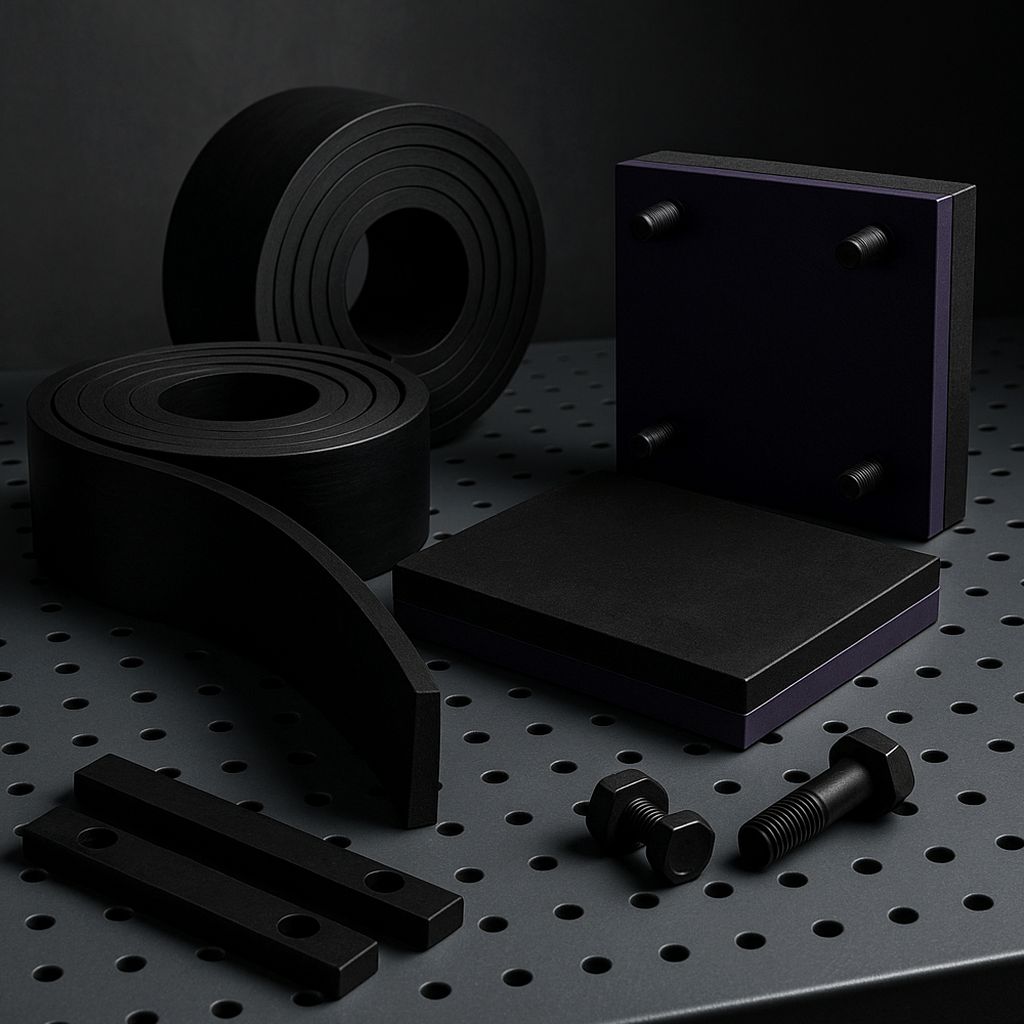
Pair with AR chute plate for the heavy impact zones and fastener kits for the clamp bars.
Request sample noteRubber for the places steel wears out first
Most liner talk is about what happens inside the chamber. A lot of the downtime on South African plants happens just after it, at the chute under the crusher and the conveyor that takes the product away. Spillage builds up under the tail pulley, a holed chute starts dropping stone on the walkway and somebody spends Saturday morning with a shovel. Rubber skirting and rubber chute linings are cheap compared to a liner set, but they decide how clean and quiet that transfer point runs.
We keep two kinds of rubber at Sunnyrock. Skirt strip seals the sides of the belt at loading points so fines stay on the belt and not on the floor. Chute liner panels are thick natural rubber vulcanised onto a steel backing plate with studs, and they bolt into discharge chutes, screen underpans and transfer boxes where the stone is already reduced and wet or sandy feed would scour bare steel.
What we hold on the shelf
| Skirt strip, general | Black natural rubber and SBR blend, about 60 Shore A |
|---|---|
| Skirt strip, fines and sand | Softer natural gum rubber, about 40 Shore A |
| Strip thickness | 10, 12, 16 and 20 mm |
| Strip widths | 150, 200, 250 and 300 mm, in 10 m and 20 m rolls or cut to length |
| Chute liner panels | 40 Shore A natural rubber, 25 mm or 50 mm, on a 6 mm steel backing plate with M20 studs |
| Panel sizes | 500 x 500 mm full panels and 500 x 250 mm half panels for edges |
| Panel weight | Roughly 19 kg (25 mm) and 26 kg (50 mm) per full panel |
| Working temperature | Up to about 70 °C at the rubber face |
A single panel is light enough for courier, so a replacement for one worn spot can reach Durban or Cape Town overnight or in two days. A full chute set goes on the next truck run with the rest of your order. Strip is cut on our bench in the yard, so you can order 7.4 m for one side of a loading zone and not pay for a whole roll you don't need.
Where rubber works, and where it doesn't
Rubber does its best work where the stone is already broken down and the drop is modest. Under a secondary or tertiary cone, after a VSI, on a sand plant or below a finish deck, lump size is usually under 100 mm and much of the wear is from wet fines sliding and bouncing. A 40 Shore panel gives under that kind of impact and springs back, where steel slowly gets scoured away. It's also a lot quieter, which the crew on the walkway will notice before anyone else does.
We will tell you straight when rubber is the wrong call. Under a primary jaw or in a run-of-mine tip, big sharp rock above about 150 mm will cut and tear rubber faster than you can replace it, and that is a job for AR chute plate or manganese. Natural rubber also swells and goes soft if it sits in diesel or hydraulic oil, so chutes near a leaking power pack need a different compound and we'll quote polyurethane instead. Hot material over about 70 °C is another no. Dry, sharp fines sliding at a shallow angle can wear rubber quicker than you'd expect too, in that case ceramic tiles or AR plate usually last longer.
Fitting skirt strip so it saves the belt
Skirt rubber should always be softer than the top cover of the belt, so the skirt wears and the belt doesn't. Set the strip so it rests lightly on the belt without being jammed down. A strip that is clamped hard against the belt cuts a groove in the top cover within weeks and still leaks once the groove forms. Clamp bars every 300mm or so hold it straight, and as the bottom edge wears you drop the strip a few millimetres and re-tighten rather than replacing it.
Storage is simple but it matters. Keep rolls lying flat, not stood on end, or they take an oval set that never quite lies down again. Keep rubber out of direct sun and away from welding sets and big electric motors, because ozone cracks the surface over time. On a Highveld winter morning 60 Shore strip is stiff, leave it in the workshop for an hour before fitting so it sits flat. Coastal sites in Durban or Gqeberha have it easier with rubber than with bare steel, though the studs and backing plates still need a coat of paint where it's chipped.
- Skirt strip softer than the belt top cover
- Light contact on the belt, never clamped hard down
- Rolls stored flat, in shade, away from welding sets
- Panels torqued evenly, studs checked at every shutdown
Ordering skirt and liner rubber
Tell us the belt width and the length of skirting you need on each side, plus the chute or underpan dimensions if you want liner panels. Photos of the worn rubber you're taking out help a lot, especially if it has cuts or has gone soft and swollen, because that tells us whether the compound or the position is the problem. If your chute has an existing stud pattern, send the hole centres and we'll match it or tell you which half panels to use at the edges.
Our parts team can look at a transfer point with you alongside the rest of a scalping screen line or crusher circuit, and we hold strip and panels at Sunnyrock for quick dispatch. Send the details through our contact form.
- Belt width and skirt length per side
- Chute or underpan dimensions and stud hole centres
- Material, lump size and drop height
- Wet or dry feed, and any oil or diesel nearby
- Site location and shutdown date
What our Crusher Wear Parts customers say
Verified Google reviews